The Dangerous Bisexual
The censorship stories of Ulysses, Tropic of Cancer, or The Last Temptation of Christ are well known with extensive news coverage and scholarly discussion. I love these stories but I’m a sucker for the small censorship case and the last few days I’ve been exploring one of those cases from Chicago in 1964. I found this case in the Library of Congress collection of Elmer Gertz’s papers. Gertz was one of America’s great 20th Century attorneys. He won parole for infamous murderer Nathan Leopold, was one of many lawyers for Jack Ruby, the assassin of President JFK’s assassin, was active in civil rights and police abuse issues, and he won (probably) the first American case declaring Henry Miller’s Tropic of Cancer not obscene while later representing sexploitation director Russ Meyer against a wave of criminal and civil censorship actions. In law nerd circles, he won a famous libel case against the racist, antisemitic, and fascist John Birch Society. And in 1964 he represented publisher Novel Books in defending their book My Bisexual 3 Years. A pulp novel no one remembers and a prosecution that received no contemporaneous attention but illustrates the odd dynamics of midcentury censorship.
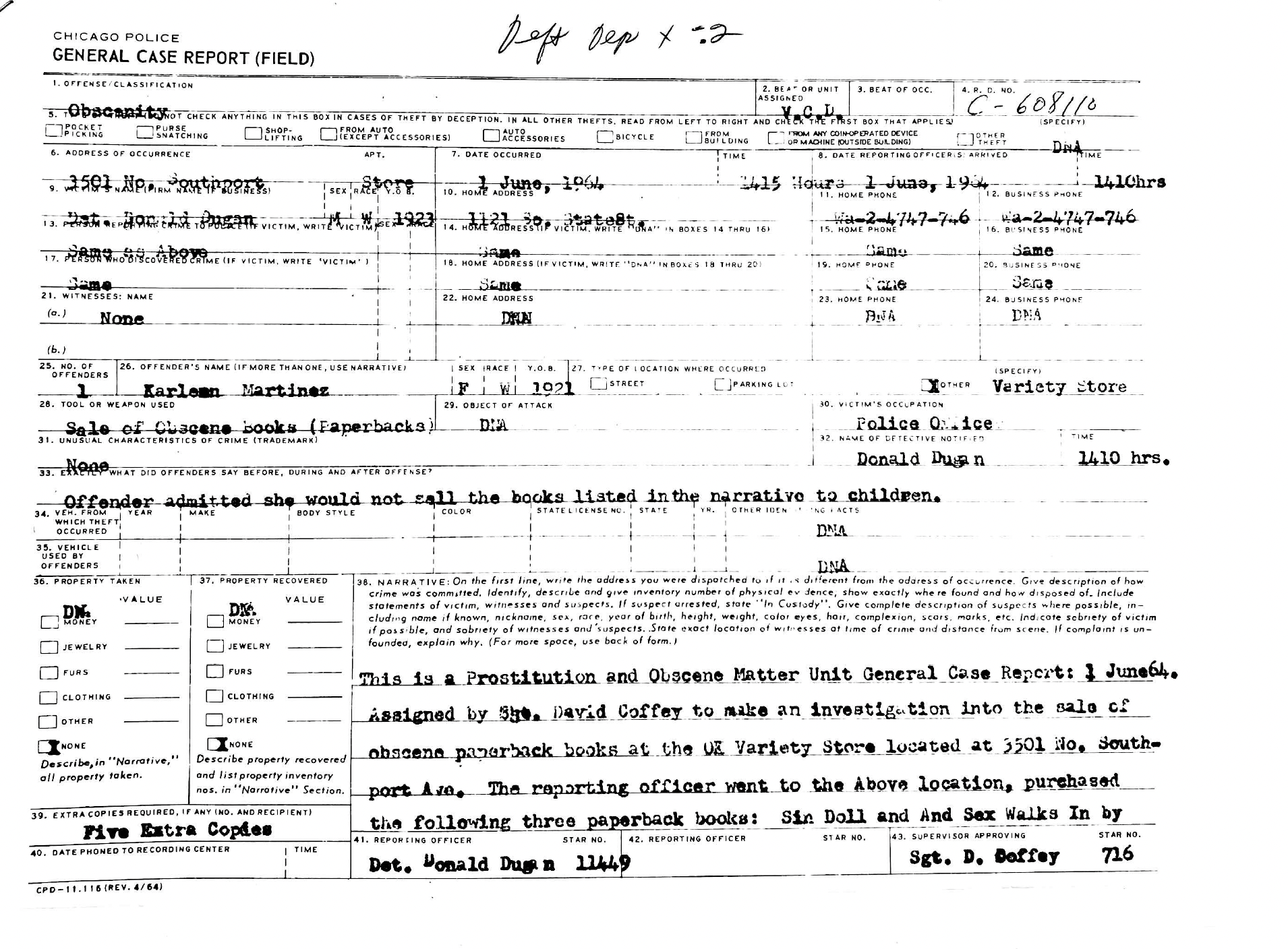
Page 1 of the arrest report.
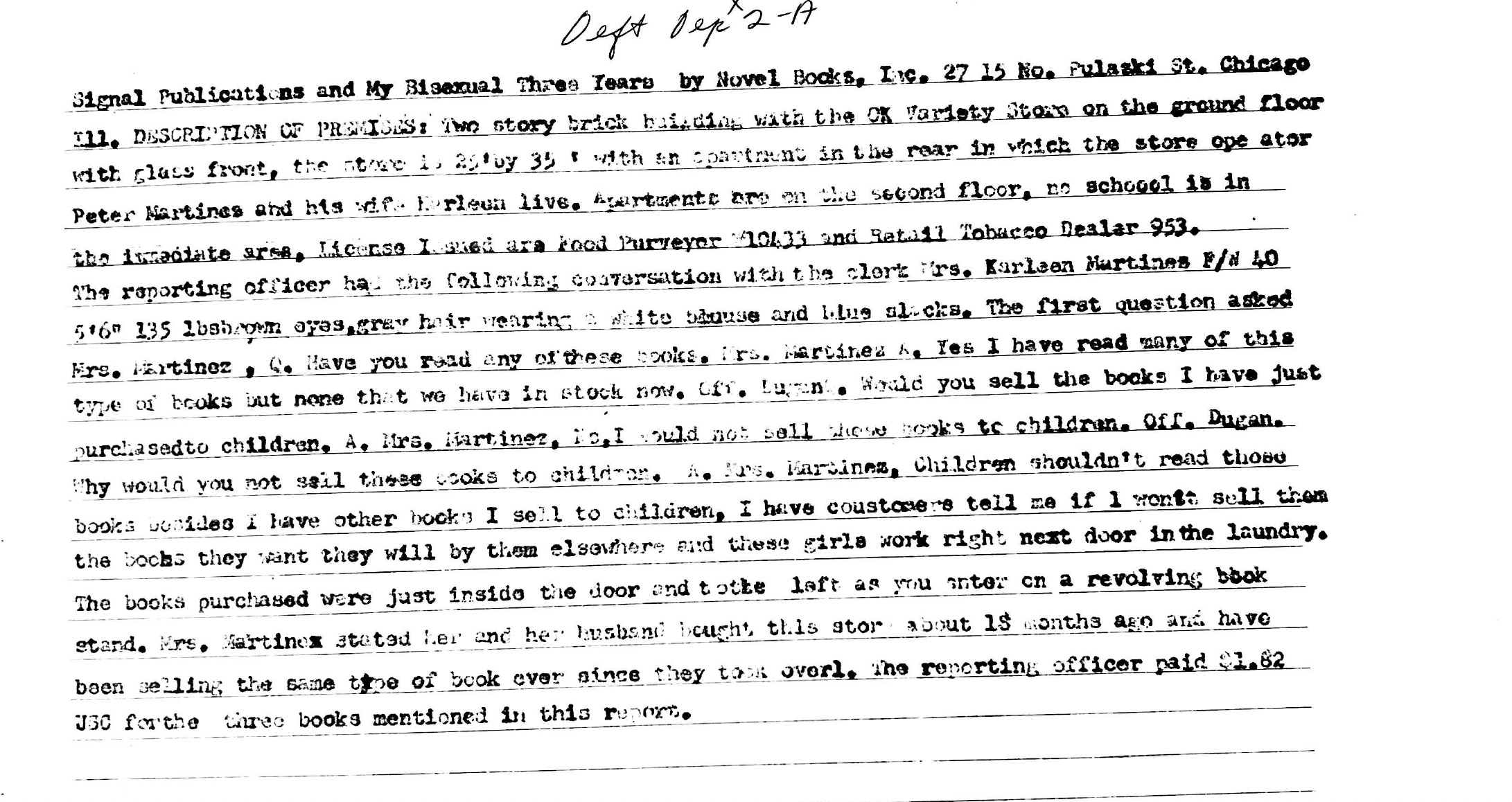
Page 2 of the arrest report.
On a June day in 1964, Detective Donald Duggan entered a Chicago variety store under orders to check for obscene books. It had a few spinning racks of paperback books and he picked up three titles: Sin Doll, Sex Walks In, and My Bisexual 3 Years. I don’t know what happened with the other two books but the last would face charges. Duggan never explained why he picked up this book. In a deposition he denied that the title was the reason but it is clear that it is all he had to go on. After all, the cover of the book was tame and mild compared to industry norms. He said he flipped through it briefly before purchasing it but couldn’t remember anything specific that drew his attention. The obvious answer is bisexual in the title was what drew Duggan’s eye.
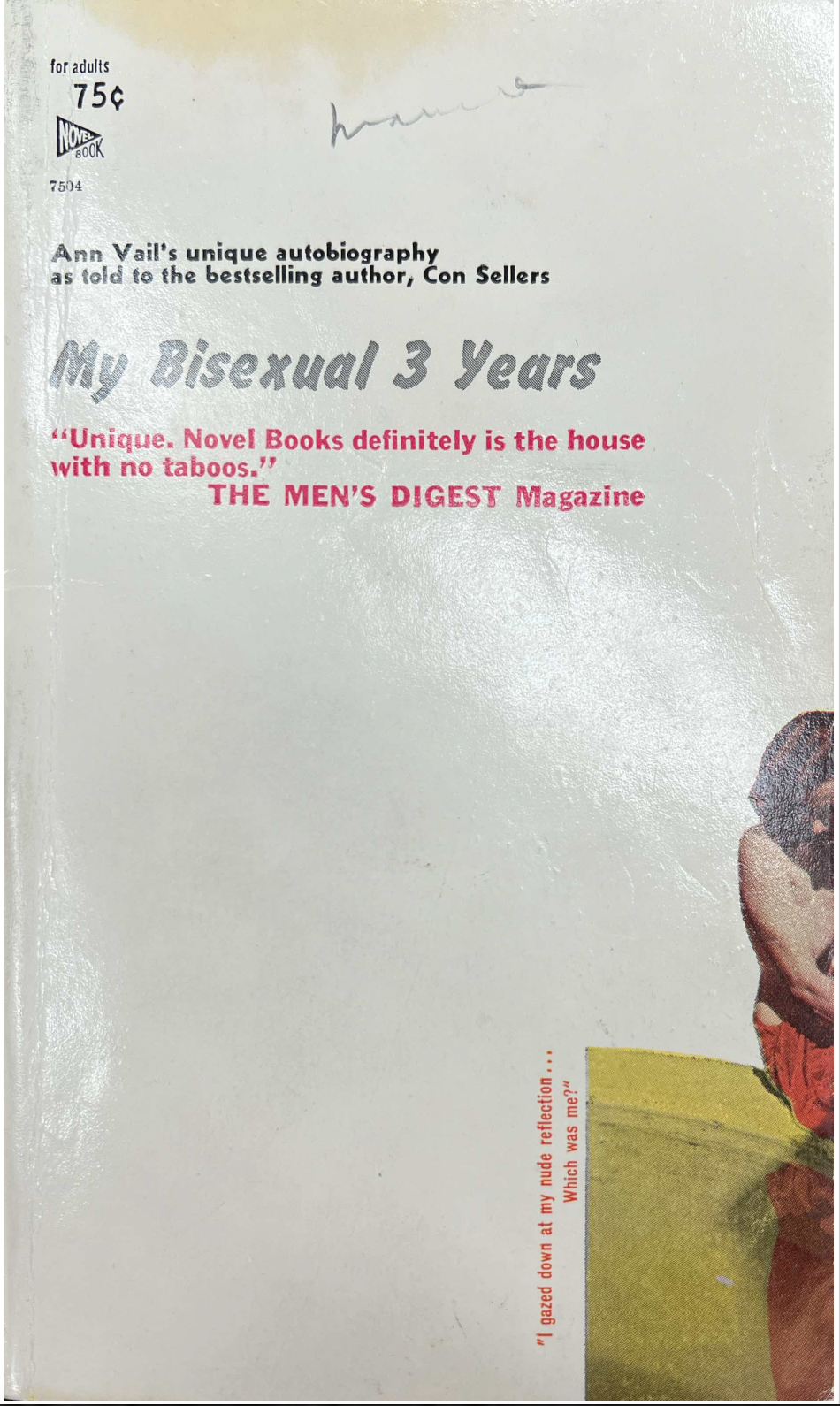
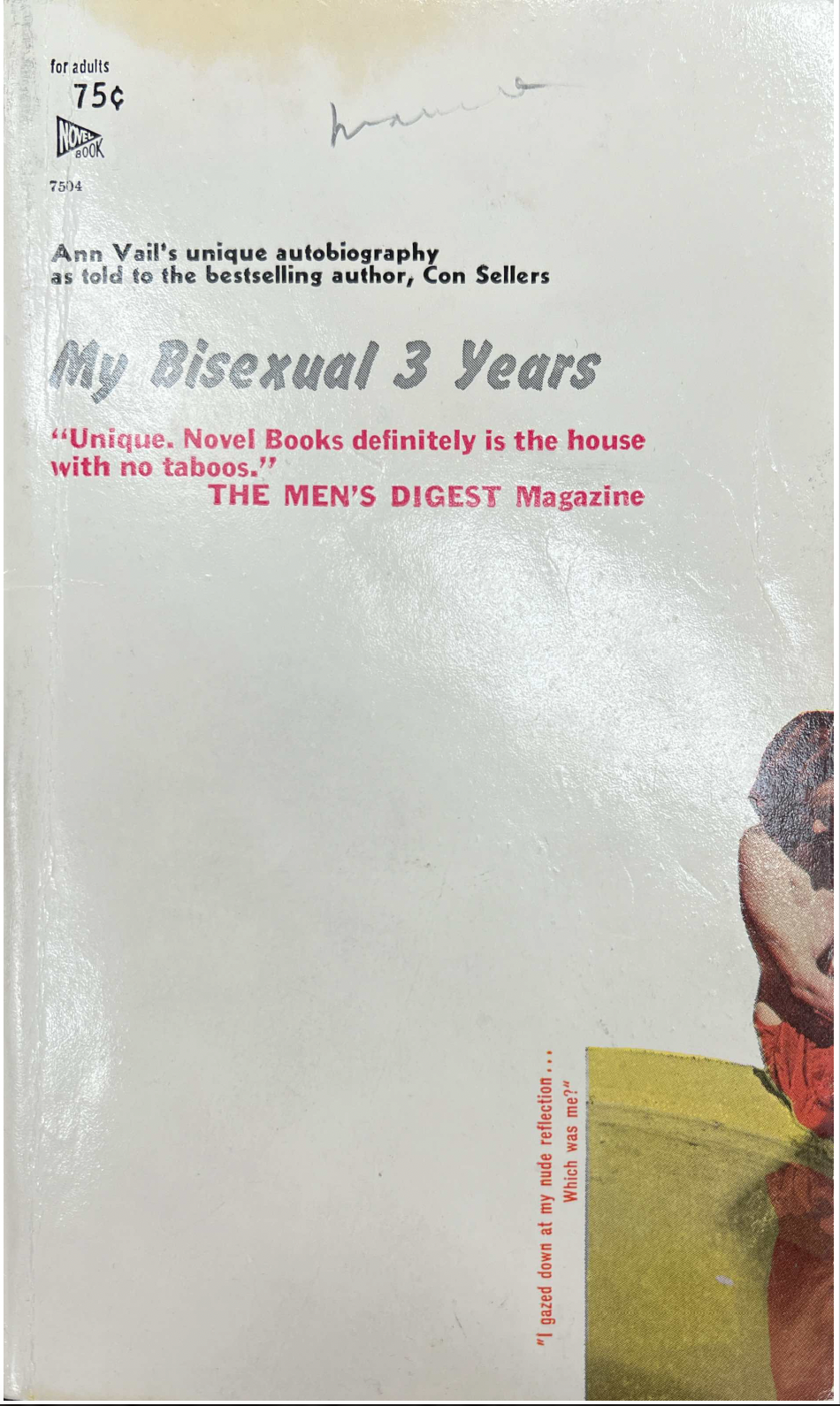
Cover of My Bisexual 3 Years. Note the “for adults” in the top left corner. Also, the quote from the magazine Men’s Digest is amusing because that was also published by the same set of companies that owned Novel Books and I believe the editor-in-chief of both was the same.
The book is fairly tame by the lesbian pulp of the era. It purports to be based on a real woman’s story but even the publisher doubted that was the case. Novel Books held itself out as a publisher of quality paperbacks and not “sex books” that it denigrated. One of the editors testified that they forbid hard swearing—meaning a few damns or hells were fine but no fucks or shits—and the sex had to be tasteful and relevant to the plot. The publisher provided Gertz with a bunch of letters to various authors asking them to tone down and rework sex and violence as evidence of this intent. Finally all of their books had “for adults” on the cover.
My Bisexual 3 Years was a tale as old as time. Ann Vail was raised by a hard military father who punished her for innocent but incestuous feelings she had as a child for her brother. After a failed, loveless marriage, she gave into neurotic impulses and had a number of sexual relationships with women while developing a problem with alcohol. Ultimately, Ann was cured by the magical penis of a good man and went back to a happy normal life. If this sounds absurd, its honestly pretty standard outline for queer pulp of the era. In a report created for the litigation, the book had 45 lines total that dealt with sexual episodes, and a third of that was the last sex scene with the man who cured Ann, but 250 lines dealing with her alcoholism.
Duggan could not recall much of this detail when he was deposed. He recalled a few mentions of alcohol but asserted repeatedly that the main theme of the book was perversion and sex, though he could not recall any specific scenes. This was pretty standard for the testimony of police officers that I’ve seen. They were trained to testify only to the general theme and avoid getting into specifics of the novel or comparative examples, such as is this book worse than some other book that was recently cleared. Prosecutors fought any attempt to ask these kinds of questions arguing that only the book itself was necessary to judge and it could only be done based on the whole theme. It was about blocking any statement that suggested bisexual equated to obscene or something else that could make the case harder to defend on appeal, if necessary.
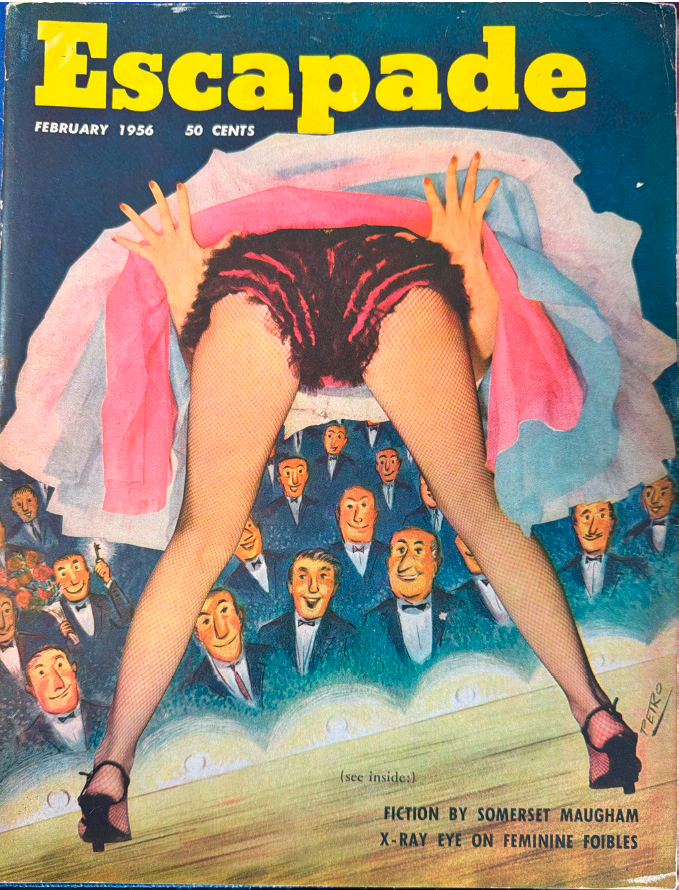
In nearly all obscenity cases of the era, prosecution focused on the book seller alone because publishers were outside the jurisdiction; I posted about this in the context of an Escapade prosecution. Novel Books, however, was based in Chicago and so it faced a quasi-criminal complaint for publishing an obscene book. The punishment was minor but the owner and editor of Novel Books were both outraged that their respectable books were being targeted for the first time and went all out in their defense. They viewed My Bisexual 3 Years as a perfectly acceptable examination of sexual deviance in modern America. In fact, Novel Books enlisted responses from critics, lawyers, and mental health professionals to review the novel with the general consensus being that it was not particularly well written but that it was not obscene and actually paralleled the then-current mental health status of sexual “perversions” such as lesbianism.
This idea of perversion and deviance pervaded Gertz’s developing defense. An editor from Novel Books wrote an entire report on perversion in the book, declaring that “Novel Books and its authors regard lesbianism as a perversion. There is no nebulous or halfway attitude toward lesbianism in My Bisexual 3 Years; it is not presented in a way which leaves any doubt whatsoever in my mind of any average reader as to its normality.” He made no secret that normal and straight were synonymous as illustrated by the finale of the novel: “This is most evident in the book’s last chapter where Ann Vail finally achieves a successful sexual union with a man, conquering her lesbianism and admitting that, at last, she has achieved normality and happiness.” This was the classic obscenity defense for lesbian pulp novels. The books were actually a warning that, yes, showed the temptation of evil gay sex but also the emptiness of such relationships and the need to become normal. This is why nearly all of them ended in either “curing” the lesbian or killing her (or another gay character). The punishment was a warning to live a good, normal life.
This defense, however, was mostly just preparatory. The simple fact is the book as described, even by police, was so tame that Gertz easily expected to win. But he was a savvy lawyer and knew that the win wouldn’t necessarily be quick or easy because the city attorney faced pressured. In fact, the case took nearly a year and a half to resolve itself. As Gertz wrote to his frustrated client, “I still have to reckon with the bad atmosphere in this community. You have to bear in mind that the police, the [city attorney] and the State’s Attorney are prodded by organizations and individuals having the greatest political potency. These people insist on prosecutions, even where the chances are that there will be an acquittal. They want to make it difficult for those who print, publish or distribute material that is offensive to them.” Gertz planned a methodical approach to get a dismissal but “even if the [city attorney] knows that he does not have a leg to stand on, the likelihood is that he will proceed with the cases.” He even admitted at one point that the case was continued until after an election to make sure an elected judge wouldn’t feel added pressure. Gertz complained at one point that it seemed like the judge and the city attorney were desperate to make the other one eventually dismiss the action that they knew they couldn’t win.
In November 1965, a new judge finally heard arguments, read the book, and dismissed the case. But Gertz still noted to his clients that at the hearings a representative of the local Citizens for Decent Literature, a powerful pro-censorship group, was in the courtroom taking notes. Gertz bragged a little at winning what was an unusual dismissal before trial against a publisher in Chicago courts.
All in all, this easily reads as a silly case. A detective picks up a book and charges are filed mostly to appease decency activists even though everyone involved knows it won’t amount to much. Had they won a conviction it would have been reversed on appeal, the examples of that are legion. Often obscenity was as much about the performance of virtue as actually winning cases. The relevant actors had to appear to be combatting smut to be effective. These kinds of low level cases were certainly the norm rather than the more famous cases but they are harder to track because even local news rarely talked about them. So it is just dumb luck in the archives that lead me to this story.
This post draws upon material across multiple folders, specifically Box 192 Folders 7-11, Box 193 Folders 1-4, in the Elmer Gertz Papers, Manuscript Division, Library of Congress. There are plural references to “cases” in some of the quotes because another company, owned by the same person as Novel Books, had a parallel criminal charged laid against Urgent Desires a straight pulp novel that Gertz was defending. Sometimes the defenses overlapped in the material for My Bisexual 3 Years. That case was also dismissed eventually by the city attorney but only after leaving it laying around for nearly two years.