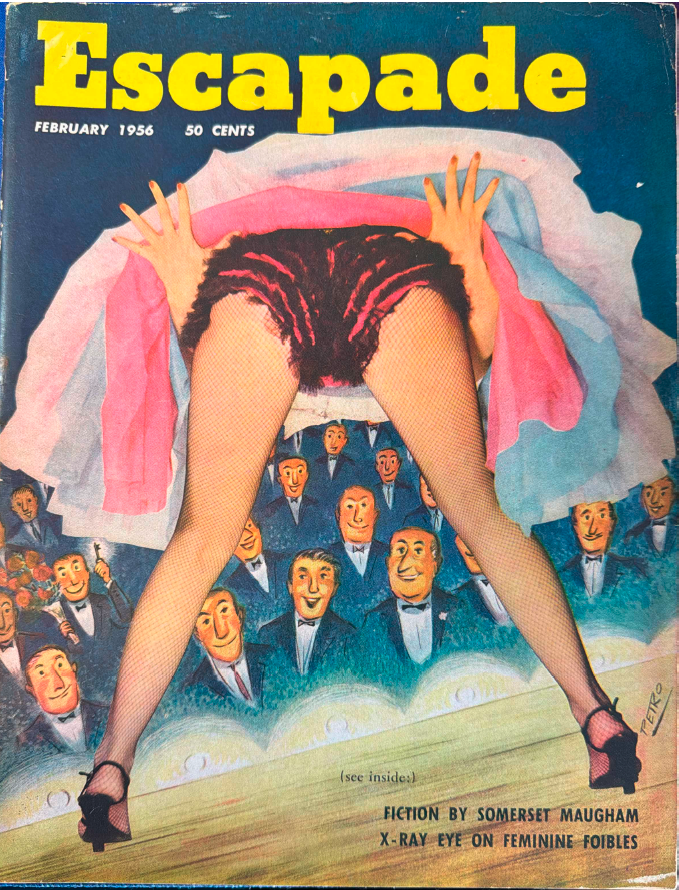
An Escapade in Syracuse
It’s been a long Spring and Summer of travel as I collect some of the last pieces of archival material for my book project on the censorship of queer material since World War II. I shared some bits found at UCLA and Syracuse University earlier this year and this post uses material found in my visit to the Georgia State Archive outside of Atlanta. I collected the records of the Georgia Literature Commission which existed from 1953 to 1974 and for a time had a strong hold over magazines and paperbacks distributed in the state. One of the lovely elements is the chair of this Commission corresponded with all kinds of censors across the country and little nuggets of fun material run throughout the collection. One of the things I discovered was a legal struggle over a men’s magazine in Syracuse, NY, that illustrates some of the tensions of 1950s America.
The men’s magazine posed all kinds of trouble to sexual conservatives in the 1950s. Probably begun by Esquire, which mixed risqué illustrations—here is an example of the images that lead the post office to argue the magazine should not be allowed in the mail—with more highbrow social commentary, news, and fiction pieces, the 1950s saw this evolve into a major segment of the newsstand. Most famous, of course, is Playboy. To the modern eye, the 1950s Playboy is so hilariously tame, at least the issues I’ve seen. Most issues only had the nude, or semi-nude, centerfold and maybe a few risqué cartoons or illustrations throughout. While tame to our modern eyes, sexual conservatives of the 1950s hated these men’s magazines because they challenged the class basis of much censorship thinking. Since at least Anthony Comstock, censors generally wanted to believe that risqué sexual content is only consumed by low class, low education perverts or children who lack the moral development necessary to resist. But Playboy and its dozens of imitators sold themselves as the magazine of high class, educated, successful men. A generation or two of suburban boys (and a lot of girls) searched their father’s possessions for the Playboys that everyone assumed they had. Sexual conservatives were desperate to stop these magazines and while Playboy quickly became legitimized, its many imitators were fair game. One magazine targeted across the country was Escapade. An issue from February 1956 is the basis of the case discussed here.
Police loved to check newsstands and other businesses for their risqué magazines and pulp novels. Syracuse police entered a cigar store and perused the shelves of reading material offered for sale with the cigars. The plain clothes officers were investigating the Escapade issue after public complaints but were surprised to not find it on the shelves. As it turns out, they didn’t find it because the owner had decided the issue was too objectionable to sell and had it in a box in the back room to be returned to the distributor. The owner, however, had taken a lunch break, and the 70-year-old former owner of the store was covering the business and when police asked specifically for the issue he remembered seeing it in the store room. He sold it and shortly was arrested for selling obscene material.
Initially the news stories did not identify the magazine and the police sources never explained the supposed obscenity more than noting suggestive illustrations and cartoons—oddly no one in the case ever mentioned the shots of a topless model. The police regularly invoked the supposed danger of this generalized content. Police Chief Harold Kelly worried that “You can’t tell what these pictures do to a young boy who gets hold of them.” (I’d say that we can tell exactly what a teen getting ahold of them is going to do). For folks of this era, it was accepted wisdom that such magazines caused sex crimes with assertions that sex offenders are often arrested with “these types of books in their possession.” This silly bit of reasoning had no real evidence to support it but police from FBI Director Hoover to small town sheriffs repeated it ad nauseam.
But the arrest of the dangerous retired store owner was not sufficient for authorities. Criminal charges against dealers are resource intensive because of due process that attaches to criminal charges. Further, they are inefficient because a mid-sized city like Syracuse might have hundreds of newsstands, cigar stores, pharmacies, candy stores, and others selling reading material. There was simply no way to target all sellers. The city attorney wanted to charge the publisher but as a California corporation New York law did not provide jurisdiction over it—he unsuccessfully lobbied the legislature to force all companies that sold magazines in New York to consent in advance to jurisdiction. The city attorney turned to an unusual statute in the New York books: a provision that allowed a city to seek an injunction against a distributor of magazines or books prohibiting distributing specific obscene materials in the city limits. If successful, this meant that no dealer would get the book and, thus, the people of Syracuse would have their souls saved!
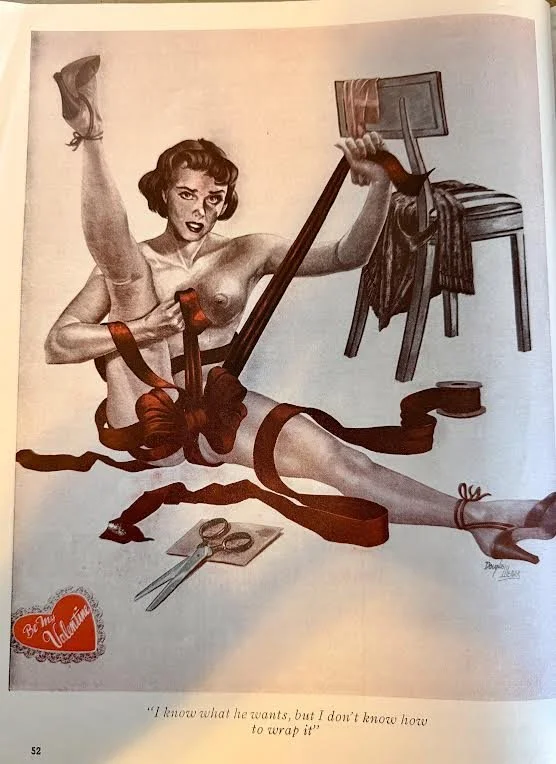
Escapade Feb. 1956, 52. This was the image noted as evidence of obscenity by the city attorney.
So the mayor and city attorney brought suit against Syrandaga, the distributor, to have it declared obscene in Syracuse. The surviving legal material can be found here; one odd note is that in New York a Supreme Court is actually a trial court and not the highest court of the state. The city attorney finally provided a few citations to the objectionable content noting primarily the above cartoon. While the drawing of a bare breast certainly didn’t help, I suspect the bow over the woman’s genitals with the implications that come with it was the problem. Then, of course, the caption was none too subtle. He argued that this and other material was “offensive to the public morals of the people of the City of Syracuse and particularly those of children attending our local schools.” The fact that there was no evidence of businesses selling these magazines to “kids”—which at the time included any one under the legal age of majority, often still 21—did not matter because censors believed that any material sold to adults would inevitably end up in the hands of children.
The funny thing is that Syrandaga did not put up much of a fight. It and the two other largest regional distributors happily announced they would work with the police so long as a proper and clear process was used. Syrandaga, in fact, pulled the February issue of Escapade upon the outbreak of the controversy. When it eventually appeared in the final hearing in the case, the company conceded that the issue was obscene. So why the need for the lawsuit? Syrandaga was happy to purge one issue, either because it truly believed the issue was bad or because it was the cost of keeping the authorities happy, but it was not willing to accept the sweeping scope of the city attorney’s attempted legal order. The temporary restraining order requested by the city and issued by the judge banned the issue specifically but also “any other printed matter defined … as obscene.” The city attorney was trying to use the injunction that was limited to a single title to broadly prohibit all questionable magazines from the distributor. It couldn’t consent to this and argued that it would be unconstitutional to prohibit unnamed issues and titles that the court had never examined. The judge must have agreed with this because the injunction was quietly modified to drop the broader reference and only prohibit sale of the issue.
So if Syrandaga conceded the issue’s obscenity and had pulled it, what was left to do? Well the Syracuse judge still wanted to write an opinion because judges also wanted to look tough on smutty books. He wrote an opinion “explaining” the issue’s obscenity. He acknowledged that the freedom of the press was implicated but freedom could be justifiably limited and obscenity is one of those limits. He rejected the idea that obscenity was too vague a term to apply: “The fact that the moral atmosphere may change from generation to generation does not militate against the statute invoked herein. We are not considering in the case at bar a publication which might be classified in the marginal gray of the common prospective. This publication is clearly within the black field of moral and legal vision.” This is the extent of the consideration of the magazine’s contents. He simply asserted that it fell into the clear black of obscenity law, no reasonable person could defend it. So no discussion or explanation of what exactly made the issue obscene. Another example of the judge being offended by the content and that being enough.
The case illustrates a common experience and mindset of 1950s obscenity enforcement. It also illustrates the futility of such enforcement. The final judgment was issued on 3 April, over a month after the issue would have been removed from the shelf in the normal course of business. Even in an exceptionally speedy legal process, a judgment could maybe limit a magazine’s market time for a week or two. In defeating the city attorney’s broader push, Syrandaga gave a victory on one issue but ensured that the process would have to target every issue of a title, and there were dozens of such magazines in the 1950s, one at a time, every single month. No city would commit the resources necessary to attempt this. But the city officials got what they wanted: some good press and an easy victory to bring up at the next election to show their moral strength. Finally, just days after the court declared the issue obscene, charges were dropped against the man who sold the issue two months earlier. The reason was not clear but it seems likely that the district attorney’s office did not see prosecuting a sympathetic old man who only provided a magazine to men who specifically requested it as a reasonable use of its resources. The air of entrapment hovered over the entire affair. So in the end, the residents of Syracuse lost access to a single issue weeks after it had already left the newsstands all to protect their fragile morals. I am certain that the consumers had no trouble finding their men’s magazines throughout the city afterwards.
The legal materials are available here: Georgia Literature Commission records Box 7, Folder: Donald H. Mead v. Syrandaga Magazine Co. I also relied upon material from a number of news stories: “Quizzed in Sale of ‘Filthy’ Magazines.” Syracuse Herald-Journal 10 Feb. 1956, 3; “Police Crack Down on ‘Indecent’ Magazines at City Newsstands.” Syracuse Herald-Journal 11 Feb. 1956, 3; “Mayor May Bolster Crackdown on Sale of Obscene Literature.” Syracuse Herald-Journal 14 Feb. 1956, 2; “‘Obscene’ Magazine Banned.” Syracuse Herald-Journal 22 Feb. 1956, 2; “Magazine Case Out.” Syracuse Herald-Journal 5 April 1956, 34; “Court Order Bans Sale of Magazine.” Syracuse Herald-Journal 19 April 1956, 3.