A Day in the Archive with Lego Richard
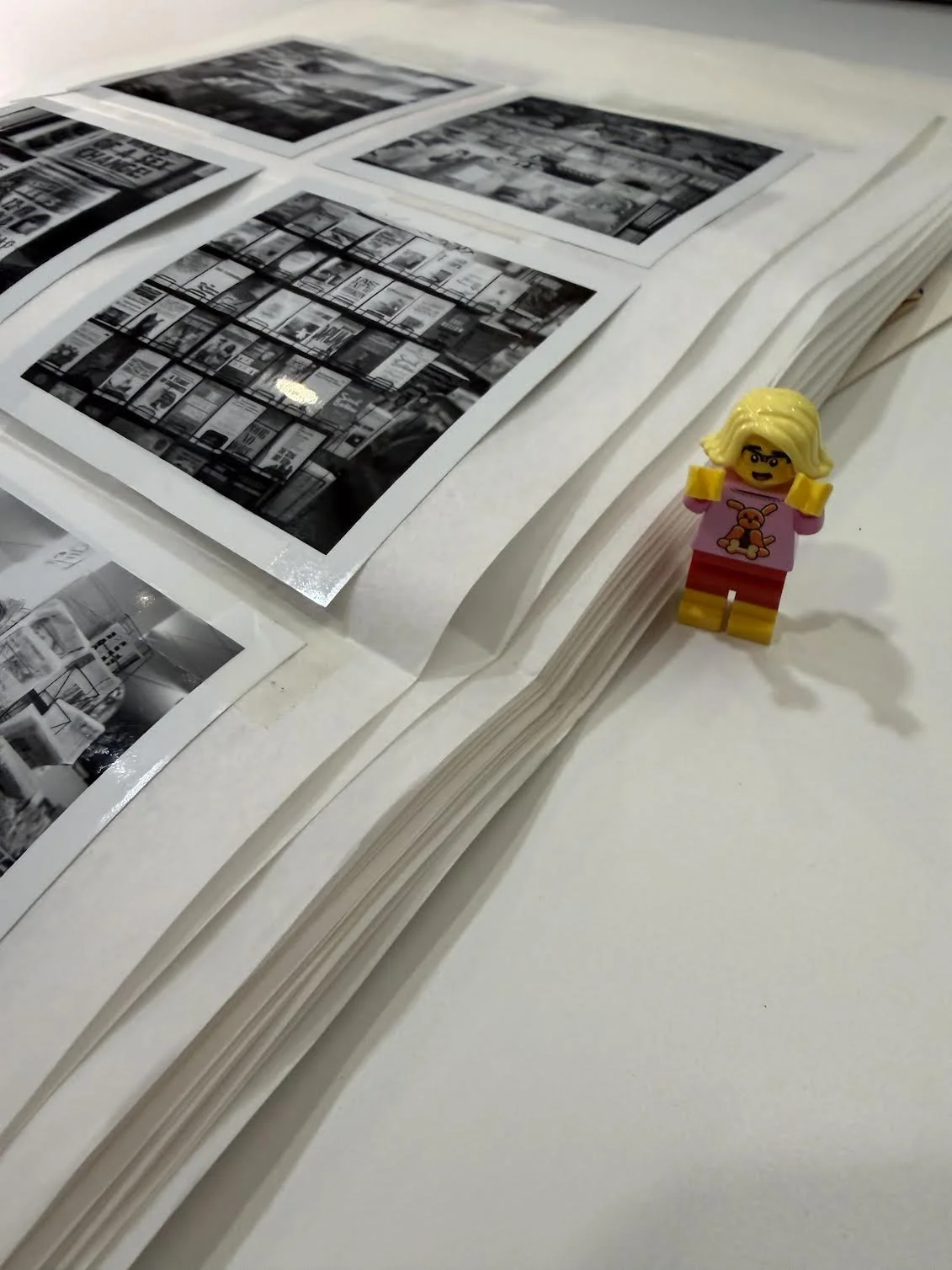
Lego Richard does most of the labor but the errors are all mine.
When I began my censorship research in late 2018, I focused only on relatively current events. This was because it was easiest to track and access through public records requests. But rather quickly I realized that there was a fun longer history. To make a long story short, for about the past 5 years I’ve spent 4-8 weeks a year in various archives tracking all kinds of stuff. Of particular interest has been the post-World War II obscenity wars. This Spring Break I’m spending at UCLA where I’m collecting material from Stanley Fleishman’s archive. Fleishman was one of the great obscenity lawyers of the era, the primary one on the west coast. He was involved in all kinds of stuff but in particular pulps and magazines. I’m primarily interested in material related to Milton Luros who published a ton of pulps, nudist magazines, and “men’s” material. He was prosecuted a lot.
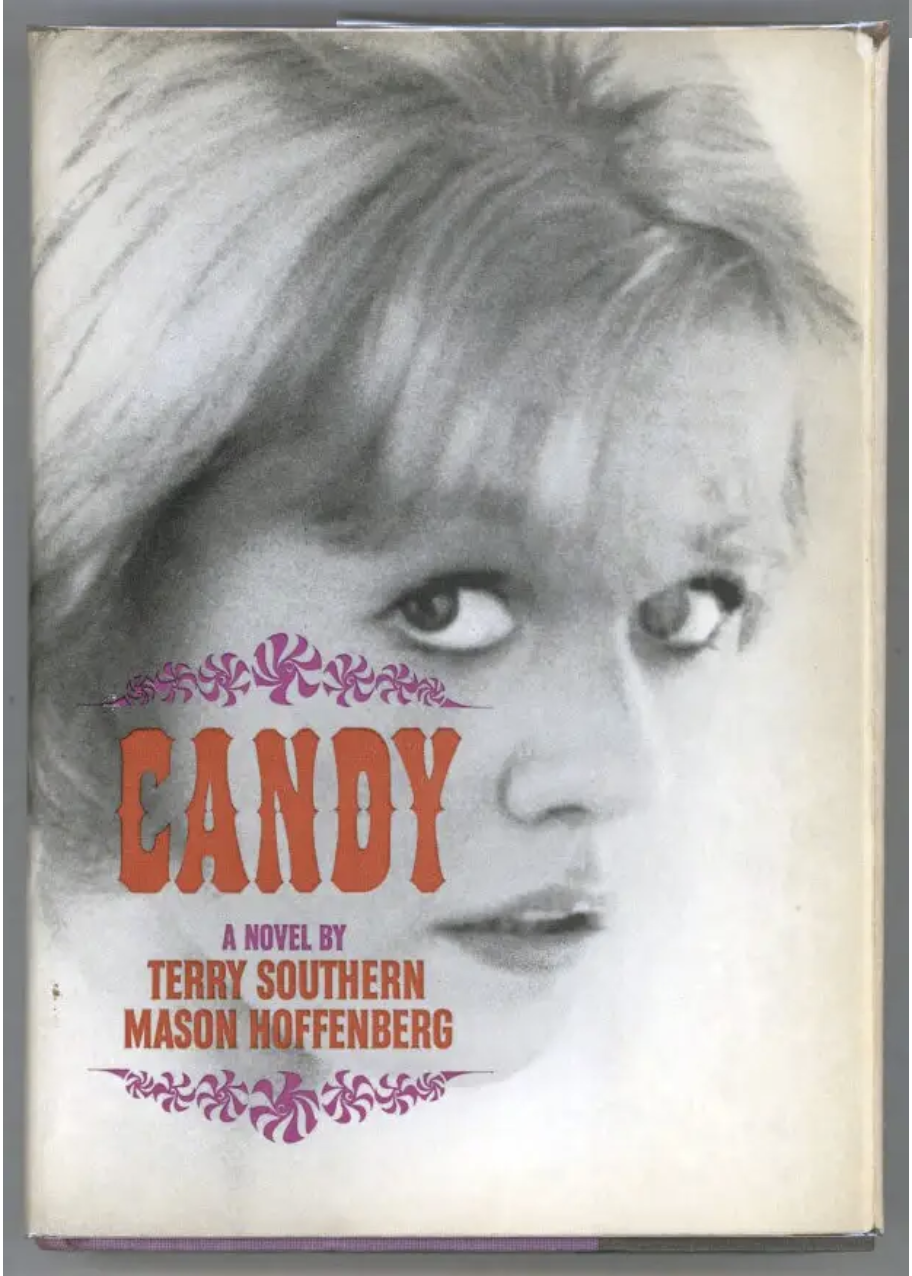
I’m interested in these kinds of legal files because reported decisions, almost always of appellate courts, only give a limited view of the reality. In a lawyer’s record I hope to find legal files with motions and testimony from the beginning of the trial but also communications with clients, and between likeminded attorneys coordinating arguments. From this I can start to see a picture of law on the ground; what it actually looked like to be arrested and charged with obscenity and the way that the state and others constructed you as a danger to society. And it is that danger that I’m most interested in. This post is focused not on Luros but on a side find that I’m excited for: materials from the prosecution of Candy by Terry Southern and Mason Hoffenberg. By all accounts Candy is a pretty filthy read but the authors stressed that it was meant to be a satirical take on literary porn of the day. Published first in France in 1958, American editions started to appear in 1964 and Candy may be the last book publish in the U.S. to generate sustained obscenity charges across jurisdictions.
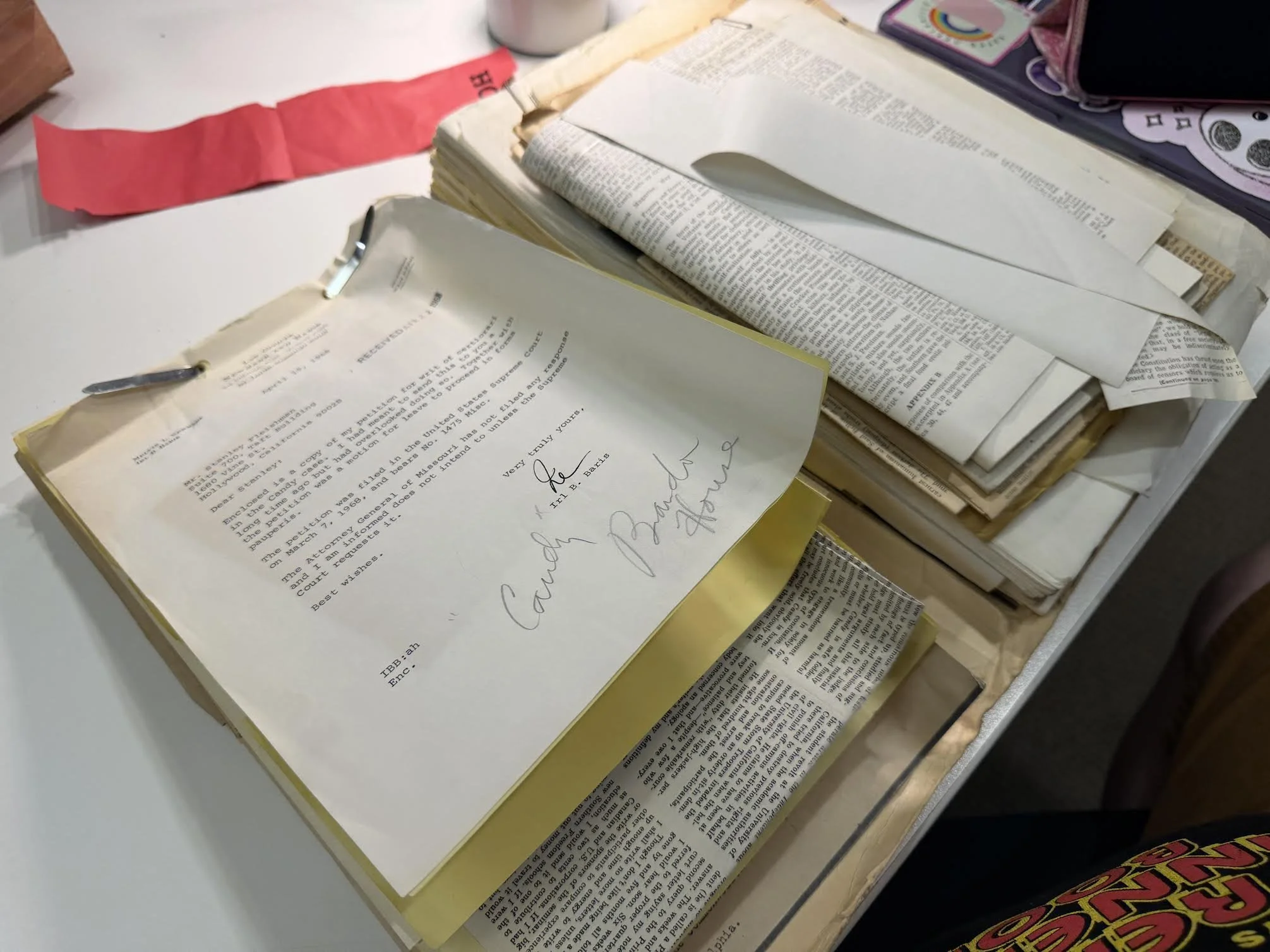
Image of the file from Box 316 of the Fleishman papers.
Archival files come in all kinds of organizational schemes, especially when they are from lawyers. Some are organized carefully, usually by the archive the papers are donated to, and placed in a clear coherent scheme. Elmer Gertz’s papers at the Library of Congress fit this description. Fleishman’s papers are the exact opposite. It appears to be in whatever order he donated them in with little rhyme or reason. So what I have here is a huge file (I scanned 465 pages) that fit a traditional lawyer’s organization. Most everything on the right of the folder is specifically “legal” in terms of filings and sometimes strategic communications with lawyers. The left side is often news stories and other ephemera related to the case in question in some way. These records allow me to track the development of a famous Philadelphia case and a less famous Saint Louis one.
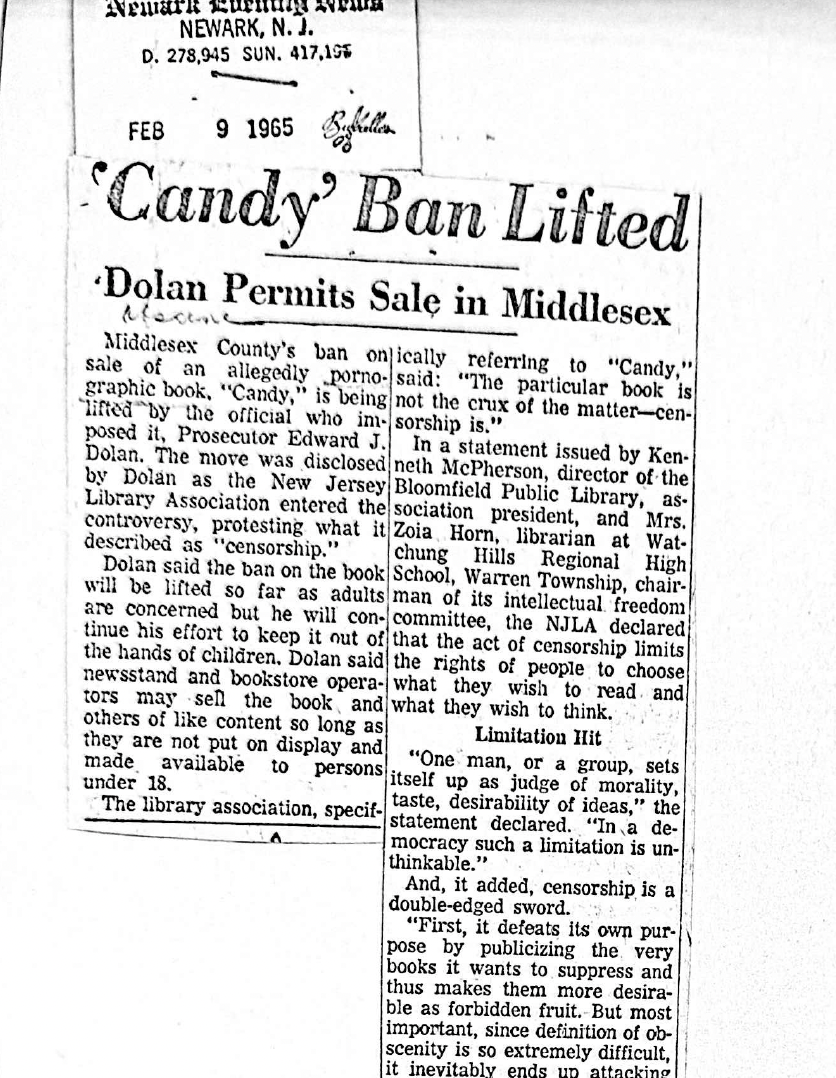
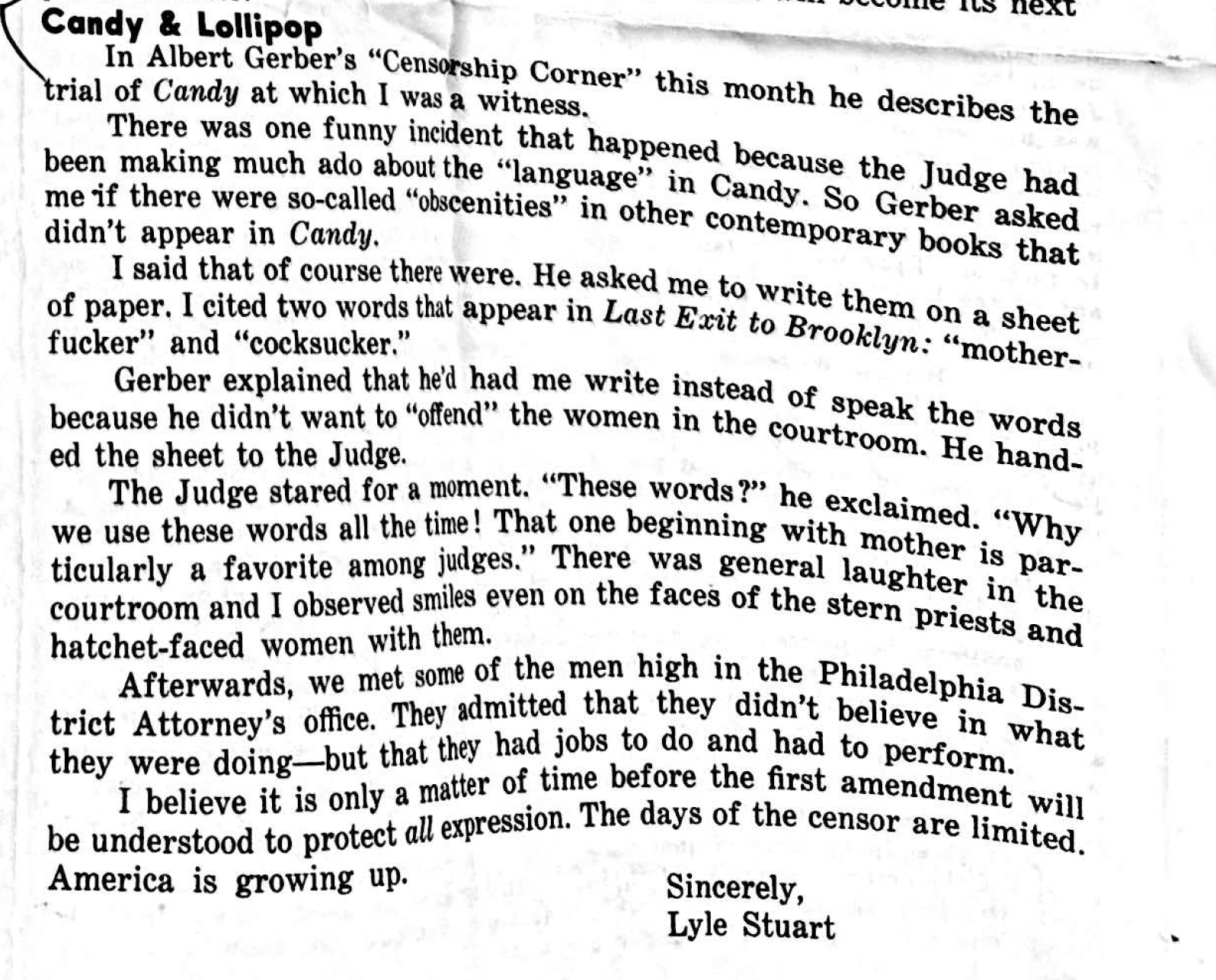
Here’s just two examples of the clippings. It helps give an idea of the weird panic that surrounded Candy. The first one specifically discusses how a New Jersey prosecutor lifted a “ban” but I guarantee he wouldn’t have agreed to this terminology. Instead he would argue that he only informed sellers of potential criminal action. Hey that seems like he was just being a good dude. But it is one of the most effective censorship strategies around. You send around some cops to warn booksellers (often newsstands rather than bookshops) that if they sold Candy it could mean charges, a public trial, and costly appeals. This pressure was one of the most common tactics to censor books in the era, and often a hard one to track precisely because it is designed to work around due process and public trials that we can follow. The second story is just an amusing look at hypocrisy. Having a witness write down filthy words – motherfucker and cocksucker – to avoid offense to women, the delicate sex who could never handle such phrases, only to laugh about how judges say motherfucker all the time. Hypocrisy and obscenity law go hand in hand.
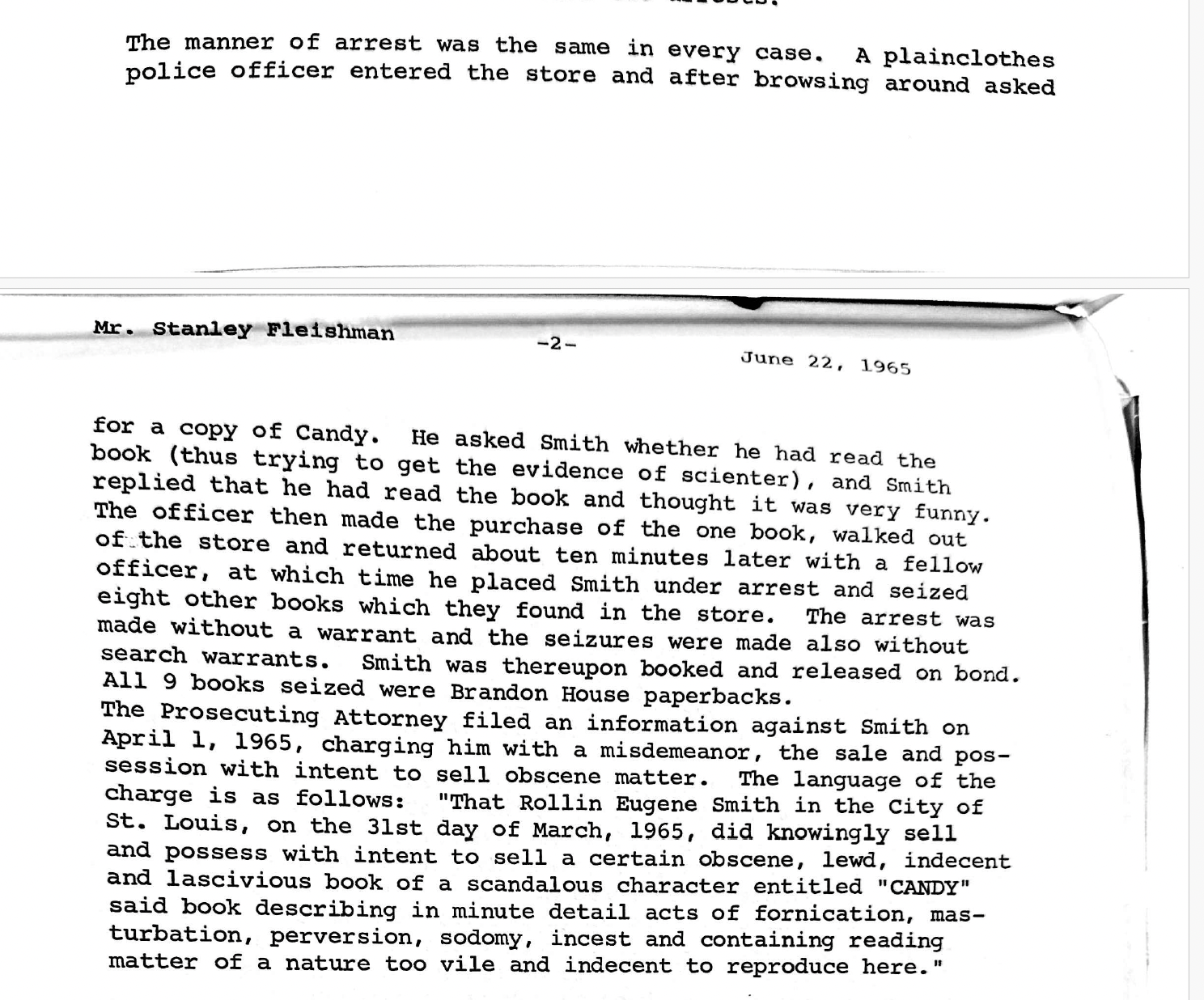
This is a bit of a 1965 letter from the defense lawyer for a St. Louis seller who was charged with obscenity. It describes the police action in the arrest. Think about being an officer in 1965 with the vice squad and going home to report your harrowing day of talking to a bookseller and then arresting him for selling a “dirty” book. That’s a weird world that a many officers lived in. This is a pretty common story. The key at arrest was to elicit statements showing knowledge of the contents of the book; this is what the letter refers to as scienter because in 1959, SCOTUS held that obscenity law prosecutions must show the seller’s knowledge of the content of the book. The best knowledge was a direct admission that they read it. But any number of other tactics existed. One of my favorites was a Cincinnati seller who had a shelf marked as 18 and over. Now most sane people would see this as a seller doing their job and making sure that “dirty” smut only gets to adults but to police and prosecutors it was used as evidence that she knew the books were dirty smut and thus had knowledge of what she was selling.
A cool find was Judge Weinrott’s trial court decision on Candy in the most well known prosecution in Philadelphia. Since this was not reported officially, I had never seen it before but here it is for law nerds. This kind of prosecution was more enlightened that in St. Louis because in Philly it was solely for an injunction against selling the book rather than putting someone in jail for selling it (though violating the injunction would be jailable). This became more popular amongst moderates who argued throwing people staffing the cash register in jail was not great. The judge held the case over hoping that a series of decisions from SCOTUS would clarify the law. He was sorely disappointed. His full opinion is actually a pretty fun critique of SCOTUS and these three cases in particular. The most famous of them is the Fanny Hill case where Justice Bill Brennan famously argued that obscenity had to be “utterly without redeeming value.” We still regularly teach that. Less well known, and far dumber, was the Ginzburg decision where the same Justice Brennan held that even where the material was borderline on obscenity – hint, nothing about Ginzburg’s publications were obscene even in 1966 – the way they were marketed could justify a conviction. This was known as “pandering” to the sex impulse. It’s fucking dumb. Even Judge Weinrott, who clearly was no fan of smut, thought so, even if he said it more diplomatically.
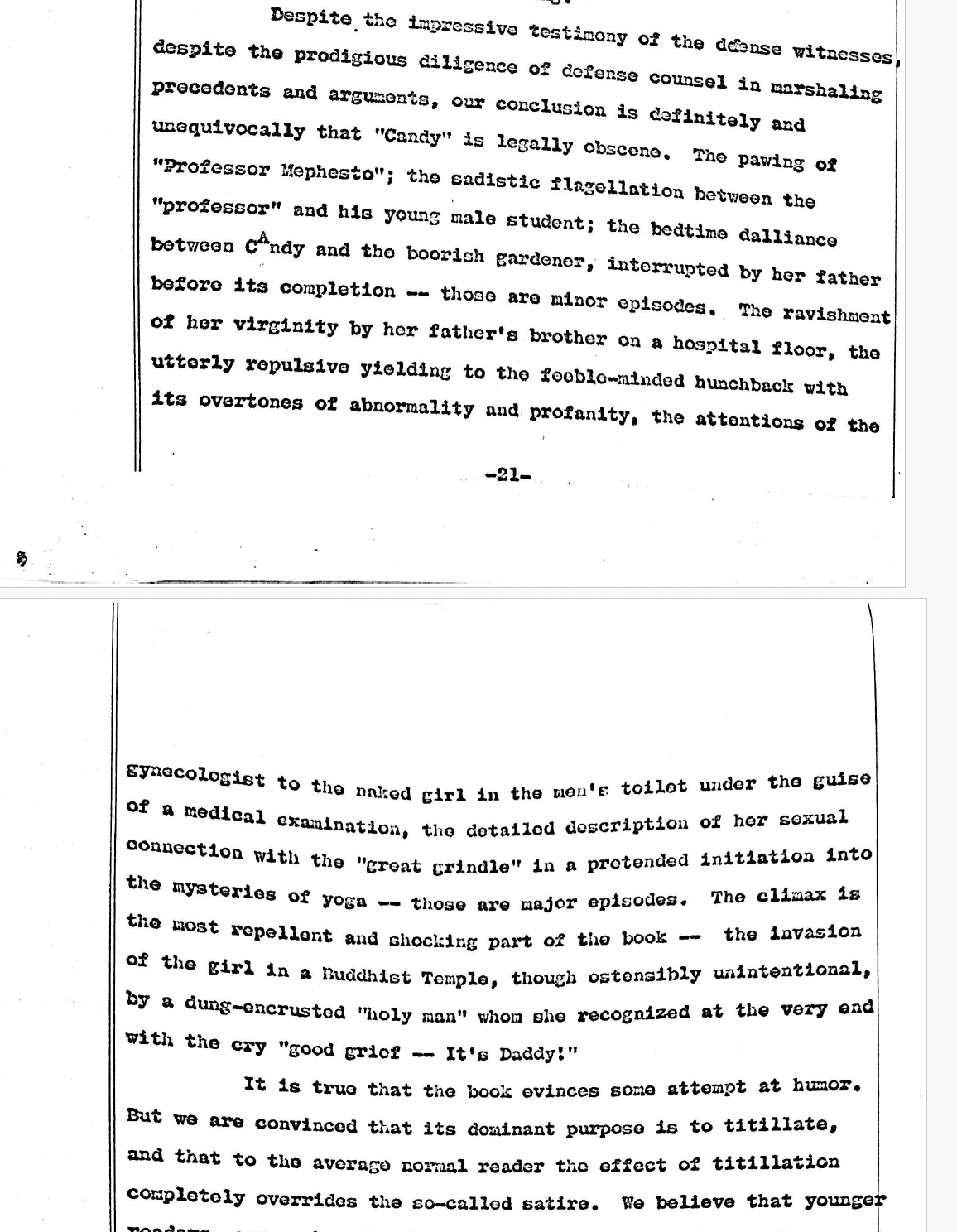
While Weinrott had lots of criticism for SCOTUS and its terrible approach to obscenity, it wasn’t because he was a friend to smut. He concluded that Candy was obscene and could not be sold in the city. He admitted that the defense of the book marshaled far better witnesses but that the book was clearly obscene. Why? Pretty much the same reason as anything was obscene at the time: it offended the personal sensibilities of the judge. When Justice Potter Stewart famously said obscenity was limited to “hard core pornography” and he knew such pornography “when he sees it” it was an honest admission of the practice of obscenity law. It comes down to nothing more than the subjective feelings of whomever is judging the case. That’s it. There is no rhyme or reason beyond that.
In closing, what amazes me is the amount of resources put into this obscenity war. Any case brought to trial involved at minimum, dozens of hours of police, prosecutor, and judicial time. A trial could last weeks, especially if books were read in full to the jury, which was not uncommon. Then there are appeals, more hours of lawyers and judges. All to convict people in crimes that, at the local level, often amounted to a small fine and at most 30 days in county jail – federally there was real jail time risked though. So why bother? Well when the Pennsylvania Supreme Court reversed the injunction against Candy – based on the fact that SCOTUS had already summarily concluded it was legitimate speech – Justice Michael Musmanno issued a scathing dissent. Musmanno is my favorite defender of censorship of his era, I regularly assign students his opinion defending film censorship. His opinion on Candy a masterpiece of censorship logic: Prohibiting the obscene, dirty, filthy, smutty literature is necessary to preserve a wholesome society.
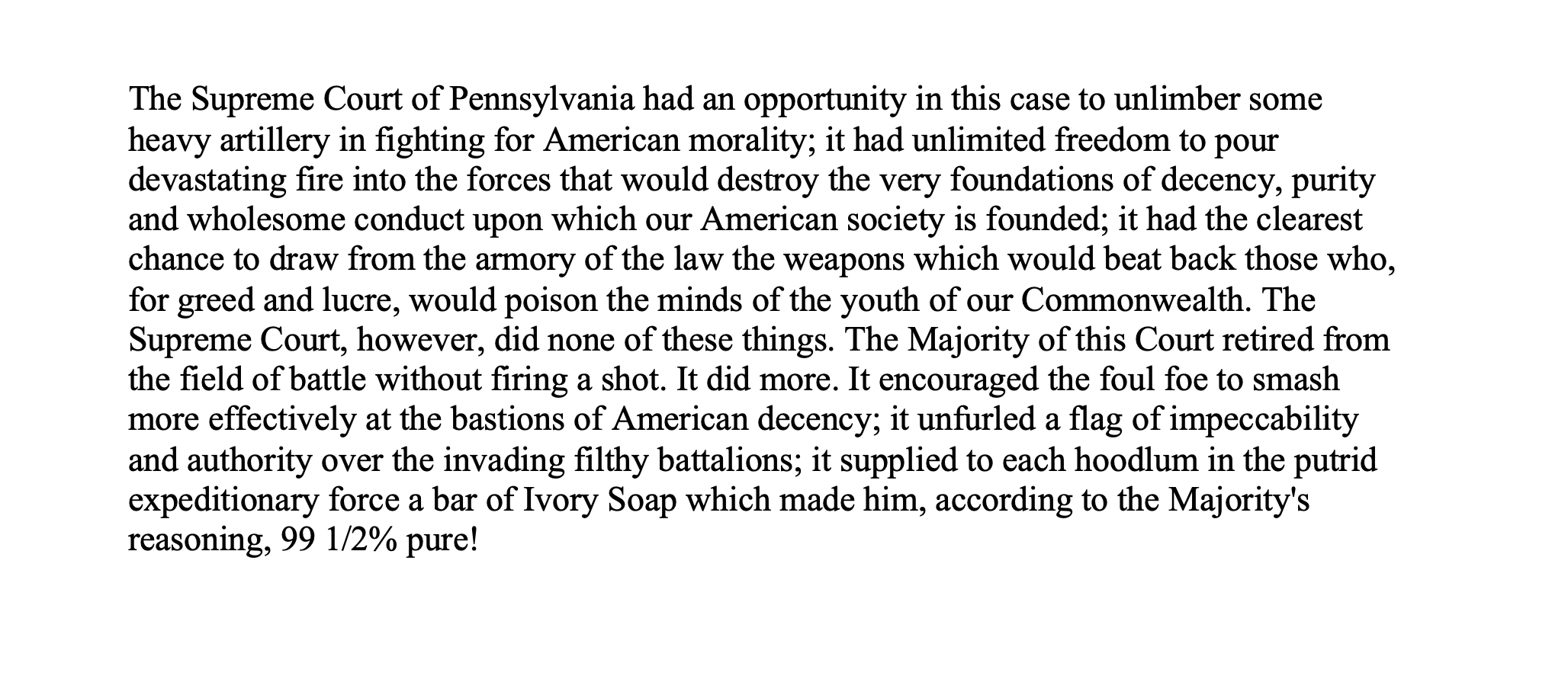
Some of Musmanno’s colorful language.
So that is a journey through a small piece of my archival process. It won’t surprise anyone who reads my writing that I think Musmanno and his ilk were grievously wrong. Society is made up of all kinds and smut is in the eye of the beholder. I enjoy sleazy 1990s erotic thrillers personally, not because they are sexually exciting but because they represent so many tropes of my childhood. But even if it was sexually exciting to me that wouldn’t change things because erotic communication is not worth less protection than other kinds of content. This is the mistake Justice Brennan made back in 1957 and sadly we still haven’t learned the lesson yet. But archival exploration lets me track and examine these competing logics over a century or more at this point. It’s a slow but fun process.