Another Day in the Archive: Naked Lunch Edition
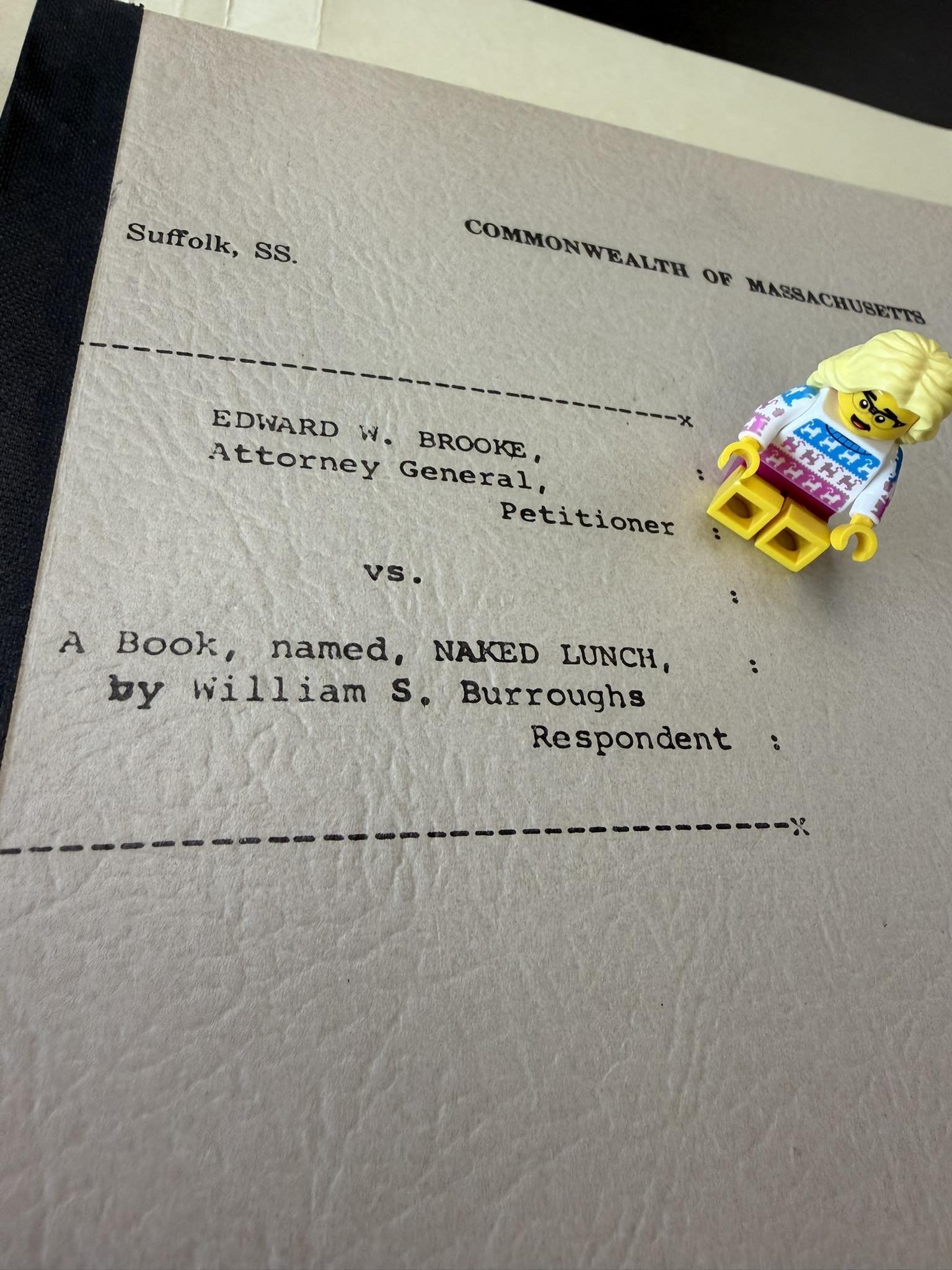
Lego Richard enjoys a good trial of a smutty novel.
I’m spending the first two weeks of (academic) summer visiting Syracuse University, my graduate school alma mater, and collecting materials from the Grove Press collection. Owned by Barney Rosset, Grove Press was an influential small press in the 1950s and ‘60s that specialized in publishing avant garde material. Grove loved to pillage the French market looking for under appreciated artists. Rosset also brought a personal mission to publishing: he wanted to break down taboos, to legalize what was once unthinkable publications. This meant willingly subjecting himself to obscenity prosecutions. One of the things I immediately came across might be called the strategy of obscenity publication. Perhaps more than any other publisher, Rossett had to be versed in obscenity law and take it into account as he brought out one book after another.
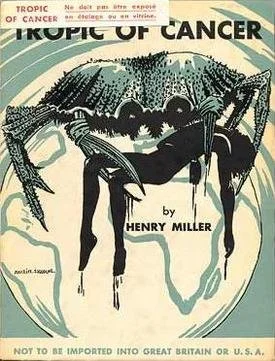
First Obelisk edition of Tropic of Cancer. Apparently Girodias designed the cover as a teenager.
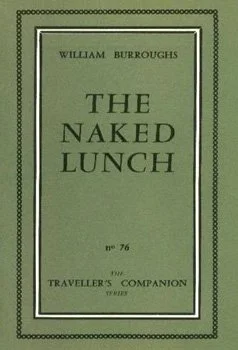
The material that intrigued me was in an exchange of letters between Rosset and French publisher Maurice Girodias. Girodias inherited his business from his father who published the famous Obelisk Press that skirted French censorship law by exploiting a weird loophole that legalized material published in English. Most famously, Obelisk published the only unexpurgated edition of Henry Miller’s Tropic of Cancer in 1934. This edition was illegal in basically every other country but it made good money as a tourist pickup or on the black market. Girodias continued the family business putting out both high brow erotic, scandalous material and less elite materials; I have no idea if it is true but apparently his detractors claimed 75% of his catalog was at best pornography. By far his biggest success was publishing the first edition of Vladimir Nabokov’s Lolita in 1955 when no English or U.S. publisher would touch it. He also published William Burroughs’s Naked Lunch in 1959. Rosset sought to published a number of titles from Girodias with his primary goal being Tropic of Cancer.
Rosset loved Tropic since 1941 when as a student at Swarthmore College he learned of the book and took a trip to the famous Gotham Book Mart in Manhattan to obtain a copy under the counter. He wrote his term paper on it and got a B- (here’s the paper from the archive). The child of wealth and privilege, Rosset purchased Grove Press in 1951 and almost immediately was focused on legalizing Tropic both because he thought the book was great but also as a thumb in the eye of American prudes. Strategically, however, he decided to bring out a book he liked less but was more favored by the elite literary circles: D.H. Lawrence’s Lady Chatterley’s Lover. He won a relatively easy victory under the new standard formalized in Roth v. U.S. (1957) where sex and obscenity were not treated as synonymous terms.
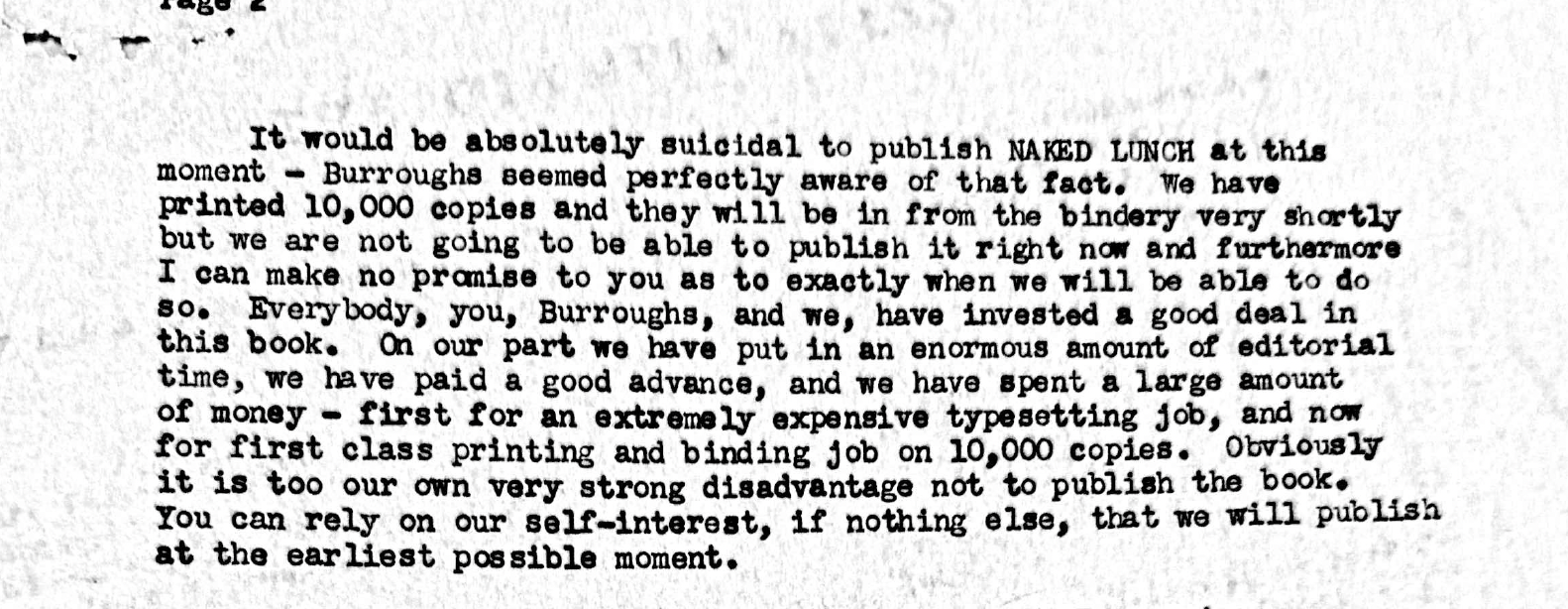
Rosset to Girodias, 13 November 1961
Then came the decision to push for Tropic which became wrapped up with Girodias’s other publication Naked Lunch by the Beat author William Burroughs. The letters that intrigued me were a series of back-and-forth exchanges between Rosset and Girodias fighting over priorities. The basic problem was that Rosset actually printed a large quantity of Naked Lunch but kept delaying actual release and that annoyed Girodias. Rossett’s point was fairly simple noting that Grove had battles “over Tropic ranging up and down the length of the country.” It is hard to express the firestorm that rained down on the publication of Tropic in 1961. This letter from November 1961, I believe only a month after the paperback was published, noted that they were already in formal legal fights in at least 10 cities but that the distributor had shipped 1.5 million paperbacks with 500,000 being returned, an unknown others having been seized by police, and some number simply being held by distributors terrified of doing anything. “There is some sort of a censorship by police intimidation and it is a very difficult thing to fight because in many places you cannot even prove that intimidation has taken place.” One example of this intimidation occurred in suburban Chicago where police chiefs in about a dozen towns sent officers out to unsubtly warn booksellers not to put Tropic on their racks. Girodias treated the decision to publish Tropic and focus on it as an act of unnecessary vanity while also acknowledging the scope of the backlash: the crisis “really surpasses anything I expected to happen. What sort of constitution do you have in that country of yours? It looks nearly as bad as France.” Rosset responded with barely suppressed outrage that he was being criticized for prioritizing Miller over Burroughs. “You do realize that Miller has a truly formidable group in favor of him – and still we are being violently attacked” estimating legal costs as of the end of November 1961 already at $100,000 (about $1.1 million today). There was no critical or literary support for Burroughs that approached anything like that supporting Miller and Tropic.
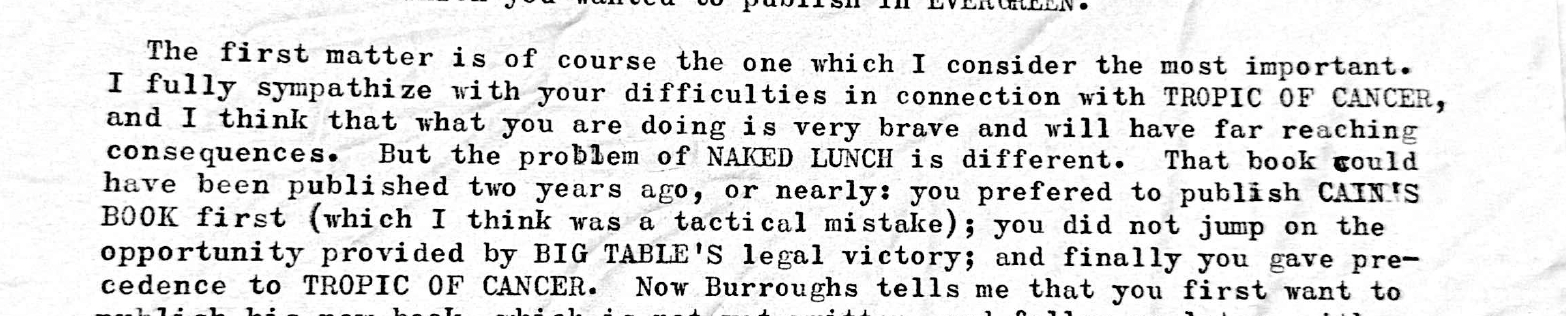
Girodias to Rosset, 18 November 1961
Giordias treated this legal expenditure as almost frivolous which set Rosset off. “It seems difficult for you to understand, but the arrests are CRIMINAL ones, and if someone is convicted he can go to jail – and even if he does not go to jail he suffers various penalties for the rest of his life because of the conviction.” The only way to ensure people would stock and sell Tropic was for Grove to agree to provide legal defense. Winning on that would open the legal space necessary for Naked Lunch. “It would be absolutely suicidal to publish Naked Lunch at this moment.” Rosset stressed that he was committed to bringing the book out but it had to be the right moment legally as well as financially.
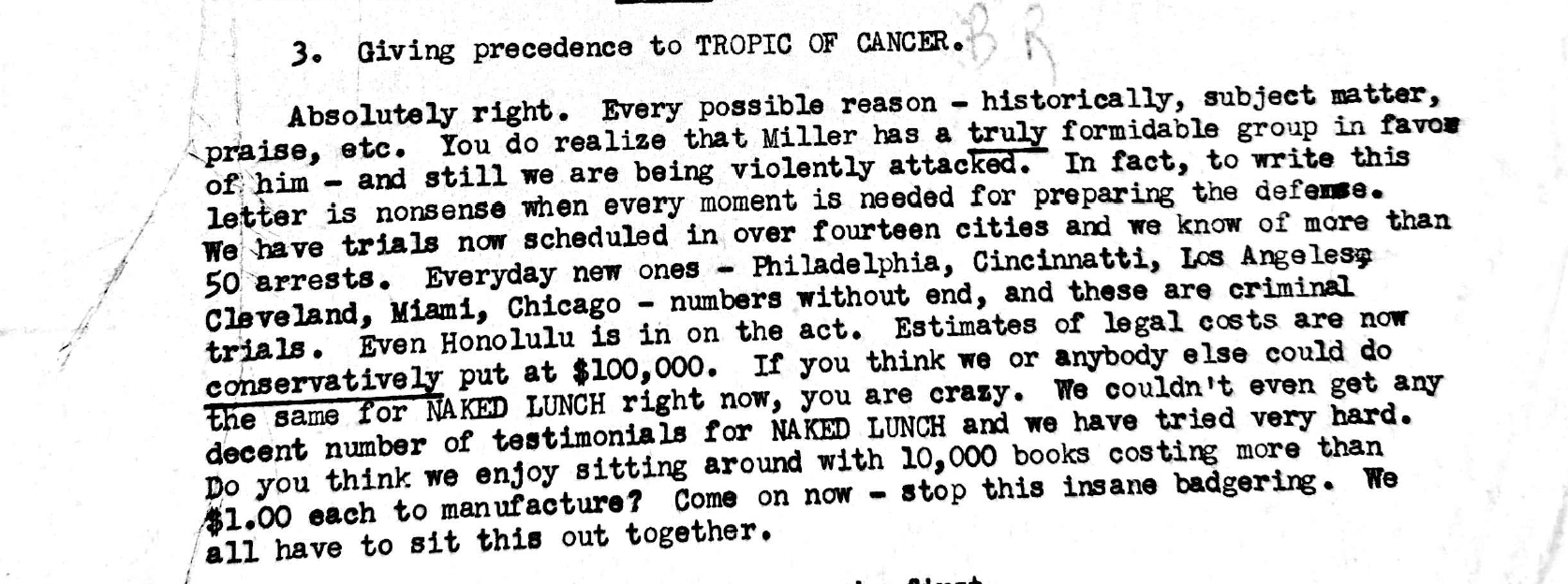
Rosset to Girodias, 29 November 1961
The nuances of obscenity law were something both men were familiar with. Giordias complained that Rosset “did not jump on the opportunity provided by Big Table’s legal victory.” He referred to a small literary magazine that made a splash by publishing Beat and other poetry and literature that they believed was being ignored by the establishment. Big Table fought and won an obscenity case centered on excerpts from Naked Lunch. But Rosset saw this victory as too limited to be of use because the sections used were “very mild and [were] completely inoffensive as compared to Naked Lunch itself.” He believed that Grove had to move the obscenity needle further to make Naked Lunch work. “If you think that Naked Lunch can be published where Tropic of Cancer cannot, then you are not only greedy but stupid.”
This flurry of letters was an eye opening find. I have relatively little from the internal workings of publishers. This kind of attention to how the law of obscenity shapes the boundary of the business illustrates the nuances that Rosset was known for. He rolled out a thoughtful and careful strategy to nudge obscenity law further and further back. Winning the legalization of Lady Chatterley’s Lover was relatively easy but crucial in shifting the landscape for literary obscenity trials. The legal battles over Tropic of Cancer dwarfed what anyone might have expected but the eventual summary reversal of a Tropic conviction by SCOTUS led to it being protected nationally. With these precedents Naked Lunch, when Rosset brought it out finally, actually found a quite smooth road. It sold well and faced only one major fight, in Massachusetts, and a small number of more minor battles defeated easily. Because of these battles, lawyer Charles Rembar would write a well-known book asserting the end of obscenity. While he was maybe a little too optimistic there, he was largely correct that Rosset’s campaign, along with many other publishers, pushed the courts to legalize literature and prose.