Living with Educational Censorship
With the end of Spring semester I find myself saddened living under an system of educational censorship. Since 2020, Republicans have imposed increasingly draconian restrictions on higher education (which isn’t to ignore K-12, just to limit my focus here). Florida has in essence forbidden sociology to be taught to undergrads if it in any way contradicts Republican ideology; this absurdity has gone so far that the state edited a textbook by removing any social science evidence it did not like especially around race in America. No institution has gone as far as Texas Tech which has not only closed all programs and courses exploring gender and LGBTQ folks but has issued a directive that faculty and students cannot even research in these areas. My experience is not nearly this extreme, thankfully, but it is just another in a step towards Republican ideological domination of education. You see, I just taught my last queer history class ever for no reason other than Republicans don’t like the subject or that queer people exist.
Maybe the surprising thing is that until recently I would say that Weber State University was actually fairly supportive. When I interviewed back in 2012, I was quite worried because of the stereotype of Utah universities. I didn’t know what to expect and I needed a job, so I didn’t say too much about the radical idea of teaching LGBTQ politics. But I was surprised to find a university that was gradually becoming more supportive. The university recognized a gay-straight faculty staff alliance shortly after I was hired. In 2015, I believe, the more supportive prior administration formed an LGBTQ resource center on campus with a staff member to coordinate events. This might not sound like much but this is Utah where the viciously anti-gay LDS church has long dominated all aspects of the state, especially higher education.
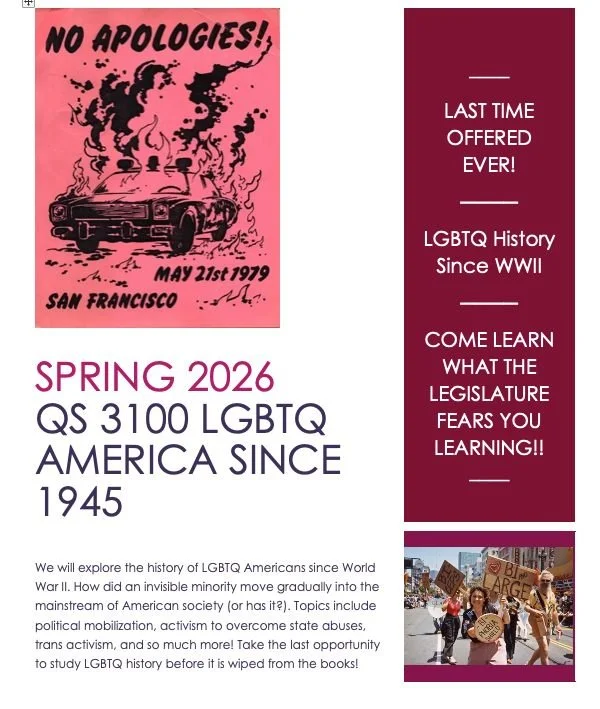
Then in 2021 colleagues succeeded in creating the state’s first ever queer studies minor. At the time, the university was quite happy to celebrate this as expanding our educational opportunities for students. Some students informed me that they came to Weber solely because of this program. It was an exciting time. I worked with faculty in other programs to expand their offerings and got to teach something new that I’d long been exploring in my research: modern queer history. I got to lead students through queer life and politics since World War II. We explored all kinds of topics but given my background as a political scientists I tended to be biased towards issues of governmental power and abuse, issues such as censorship, police power, educational activism, constitutional advocacy, and similar things. It was informative and, I think at least, fun, and student response seemed excited. Then statewide politics shifted with the times.
In 2024 the legislature adopted one of these awful anti-DEI bills that used a lot of words to ban things that did not happen in the real world. But the point was to threaten schools to back away from talking about race, gender, or sexuality. And Weber State rushed to immediately comply, actually over-comply. Our then-president, who thought his job was to bend over backwards to please Republicans, ordered all identity resource centers to be closed. This had its intended effects of making students of color, queer students, non-Mormon students feel less included and welcomed at the university. That’s the point of anti-DEI laws. Then came the 2025 budget cut when the legislature announced that 10% of every university’s budget would be cut for no economic reason. Meaning the state budget was more than healthy and higher education enrollment was actually stronger than expected. So why do it? Because they wanted some programs closed and the money “reallocated” to other things, like fucking AI. They didn’t have to explain what programs to target, everyone knew what “efficiency” meant. Programs in the arts, humanities, and social sciences were to be cut and programs in business and tech expanded.
The ideological basis of this became clear when - according to folks who tracked this closely - the measure of “efficiency” was changed so that economics wouldn’t be targeted for cuts. The goal was to cut programs like anthropology, philosophy, and sociology, not something supposedly “objective” (meaning presumptively conservative) like economics. So the measurements had to change. One outcome of this was the elimination of Women, Gender, and Queer Studies. The funny thing is that these programs did not actually fail the efficiency standards because we didn’t actually spend much of anything on these programs. Queer studies largely relied on the existence of courses in other programs, like in English, or labor of faculty at almost volunteer level, which I and others did. Basically this was a passion project we engaged in for students. But that didn’t matter because our former administrators knew that Republican legislators would not allow the program to exist even if it barely used resources. So they closed it anyway.
So what is lost in all of this? Well my modern queer history course died. Admin will tell you that no courses were affected by the budget cut but when the program died it is hard to understand how one can teach a queer studies course still (I can’t). There’s the smaller effects on me such as how a few years ago admin would regularly encourage me to think up a trip to take students on like queer history in San Francisco or New York. That kind of encouragement went away quickly. No one really wants to talk about my work too much or mention it outside of confidential annual reviews where I get high praises. But really the effect on me doesn’t matter that much to me. Well other than the hope that a better job comes along.
The real thing lost is the opportunity for students. The skills aspect of the class can be developed in other similar courses; any advanced history or social science is going to have aspects speaking to skills in argument comprehension, textual analysis, and development of written and oral skills. But the content is what is lost. Not only the content but the joy that so many students got in seeing their lives as part of a historical narrative for the first time. Time and again I saw a lesbian student get excited at learning about Del Martin and Phylis Lyon or the lesbian feminists of the 1970s. Trans students got to see and learn stories of folks like the eccentric Reed Erickson or the rebellious Sylvia Rivera. When we talk about queer existence in secondary education, students got excited recognizing the parallels in their own lives for good or ill. And contrary to claims of Republican anti-diversity advocates this was not an exclusive class. Straight students were in all three semesters I taught it because they can learn interesting things as well, just as white students can learn fascinating material from Black or Indigenous history. But there is something magical about seeing queer students existing in maybe the only educational space they’ve ever been in where everything comes in their voice, in their perspective rather than privileging straight life as everything else we teach does. In closing queer studies the message of Weber State and the Republican Party is that this content is not only irrelevant, but actually detrimental to students. Queer students shouldn’t exist.
The university would respond that the minor was small so who cares? Well as it didn’t cost much of anything, why close it if it had an audience? For now, I’m still allowed to teach LGBTQ politics because it is a political science course but I have no idea for how long. If Utah goes the route of Texas, which it has been following behind slowly, it will only be a matter of time. We are hiring a new president under a veil of total secrecy and lack of input so for all I know we will get a partisan hack who will take a hatchet to the university. Regardless of the future, the last few years have been hard and watching our educational mission undermined time and again is demoralizing. But I will regret what some students will not get now because the state and administration don’t think they are valuable enough to consider.