Bigotry and Free Speech in Utah
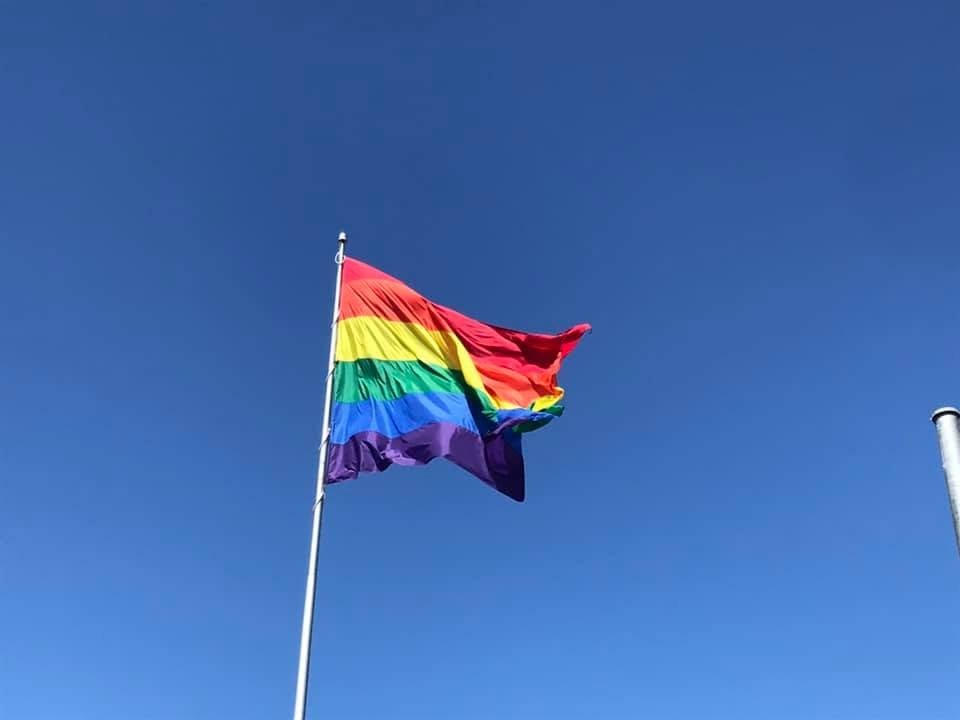
Utah Republicans have a real problem with free speech, well when the speech is something they dislike. You can see this today in an absurd fight over Centerville City Council member Cheylynn Hayman placing a small pride flag next to her nameplate during Council meetings. In any normal place, this would elicit at best shrugs from people. In Utah she and the city are being threatened with legal action because certain members of the state legislature cannot handle the fact that Hayman enjoys the right to express her views.
You see, Utah based HB77 last year prohibiting governmental entities from displaying LGTBQ Pride flags. It was framed as any “political flag” (pretending that the U.S., state, and local governmental flags aren’t political) but the real target was Pride flags. The law was pushed by Representative Trevor Lee one of the prime bigots of the Utah legislature and, I just learned, an admitted fraudster as well as an alleged corrupt representative. Lee is convinced that Hayman is violating the law because she is an “employee” of the state and is thus bound by the law. This is so blatantly stupid that it is impressive. The logic alone is absurd. The law makes it clear that any attempt to limit Hayman’s speech is unconstitutional and illegitimate.
Sadly, the Pride flag ban is constitutional in broad terms. The state can decide what it, itself, wants to say and what it won’t say. It can prohibit the government from flying Pride flags - though lets remember how Salt Lake City just incorporated these dangerous “political” symbols into official flags, a lovely little loophole. Relatedly, the government can limit the speech of employees when on the job; a police officer, receptionist, or janitor could be forbidden to wear a Pride flag pin on the job. These are well-established basic principles. But this does not help Lee’s argument.
Hayman is not an “employee” of the state. She may be paid by the government but she is an elected representative. Her only boss is the people of her constituency. To take Lee’s argument seriously, it would mean that the state could prohibit an elected official from stating their political beliefs. If that sounds stupid, it’s because it is fucking absurd. The entire point of having elected officials is to have them express their views so the public can decide on whether it wants them in office or not. The placement of a Pride flag clearly qualifies as such speech as any rational person would both understand it to express a message and Hayman clearly intended to advocate a message (we call this the Spence test). But we don’t have to reason from obvious basic principles. SCOTUS has already explained this issue.
In Bond v. Floyd (1966), a newly elected member of the Georgia House of Representatives was denied his seat because he opposed the Vietnam War. (And he was Black, that was probably a bigger deal). Georgia admitted that a private citizen could criticize the war and the draft but that it had a legitimate interest in applying greater restraint on elected representatives. SCOTUS expressly rejected this claim. “The manifest function of the First Amendment in a representative government requires that legislators be given the widest latitude to express their views on issues of policy.” The idea that representatives should be given less speech protection is absurd: “Legislators have an obligation to take positions on controversial political questions so that their constituents can be fully informed by them, and be better able to assess their qualifications for office; also so they may be represented in governmental debates by the person they have elected to represent them.” SCOTUS reinforced this rule in 2002 when it held that Minnesota had no legitimate interest in limiting candidates for judicial election from announcing political beliefs. To limit an elected official, or a candidate for office, from expressing political beliefs undermines the very purpose of representative democracy.
Lee wants folks to believe this is about “neutrality” in government. Unfortunately for him, there is no such thing as neutrality in politics. Here the issue is inclusion or exclusion of queer people from Utah politics, there is no middle ground. Lee, Governor Cox, and their bigoted pals believe that queer people shouldn’t exist and one means of achieving that goal is to hide us from existence. Hayman refuses to accept that exclusion and instead stands up for inclusion of all Utahns in government. While this message could cost her the election, Hayman has not only the right but the duty to express her beliefs so that the voters can judge for themselves.